

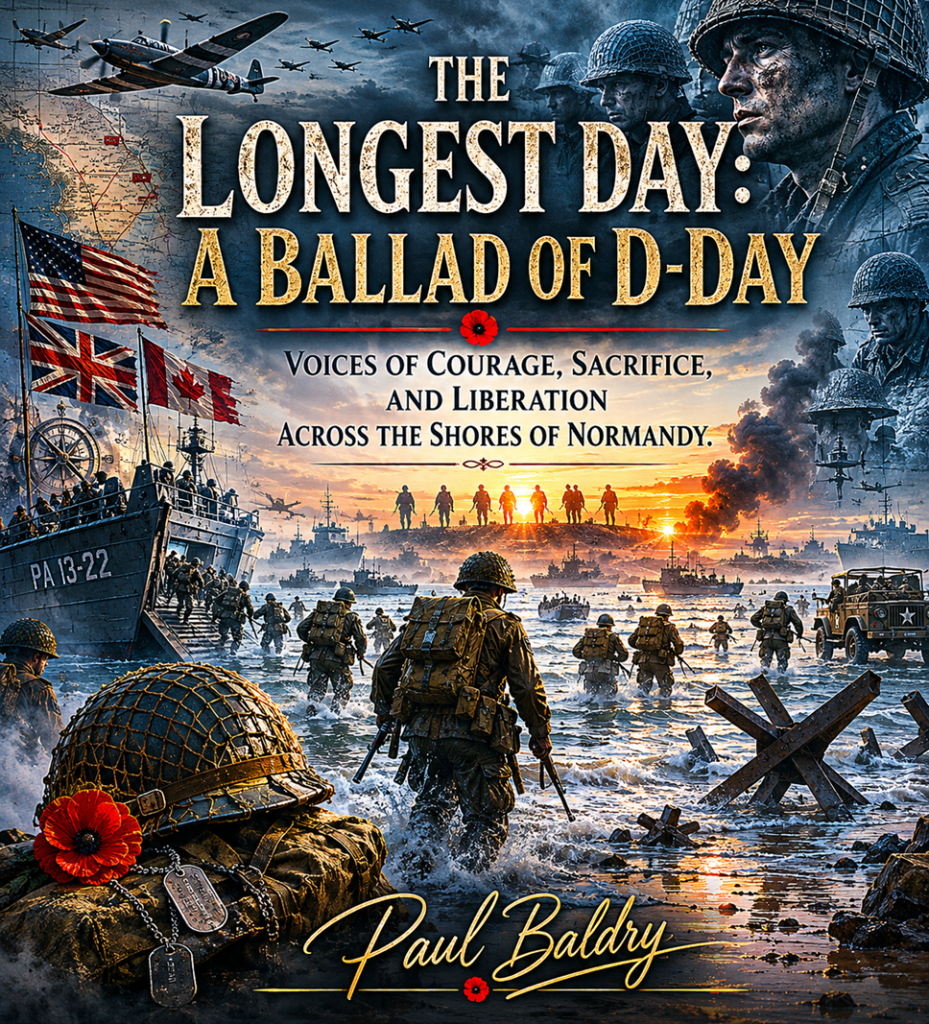
Voices of Courage, Sacrifice, and Liberation Across the Shores of Normand
I wrote The Longest Day: A Ballad of D-Day to honour the courage, sacrifice, fear, and humanity of all those caught within the events surrounding the Normandy landings of 6th June 1944. This epic ballad unfolds across six interconnected poems, each reflecting a distinct stage of the great invasion—from the final preparations and departure from Great Britain, through the perilous Channel crossing, to the fierce battles fought upon the beaches and beyond on the shores of France.
For many years, I have written poetry inspired by the events, battles, and personal stories of the Second World War. Those individual poems sought to preserve moments of history through verse, giving voice to soldiers, civilians, and those whose experiences might otherwise fade with time. As my collection of wartime poetry grew, I felt compelled to bring together both earlier works and newly written pieces into a single, unified narrative. The result is this six-part ballad, an epic poetic journey that follows the path of D-Day from its planning and departure to the hard-fought struggle for liberation in Normandy.
Through the voices of Allied soldiers, German defenders, Resistance fighters, commanders, and ordinary civilians, these poems seek to capture both the horror and the hope of one of the most significant military operations in modern history. They tell a story not only of conflict, but of duty, comradeship, endurance, and liberation.
In writing and creating this ballad, I have drawn upon historical accounts, official records, eyewitness testimonies, and several well-known quotations from soldiers and leaders who experienced these events firsthand. While poetic in form, the work remains rooted in the realities of D-Day and the immense human cost paid by those who fought, suffered, and died.
More than eighty years later, their voices still deserve to be heard. This ballad is offered as a tribute to all who took part in that extraordinary day when the course of history turned upon the courage of ordinary people facing extraordinary circumstances. It is also a tribute to the enduring power of remembrance, ensuring that the stories, sacrifices, and lessons of D-Day continue to resonate with future generations.
Paul Baldry (LongJohn)
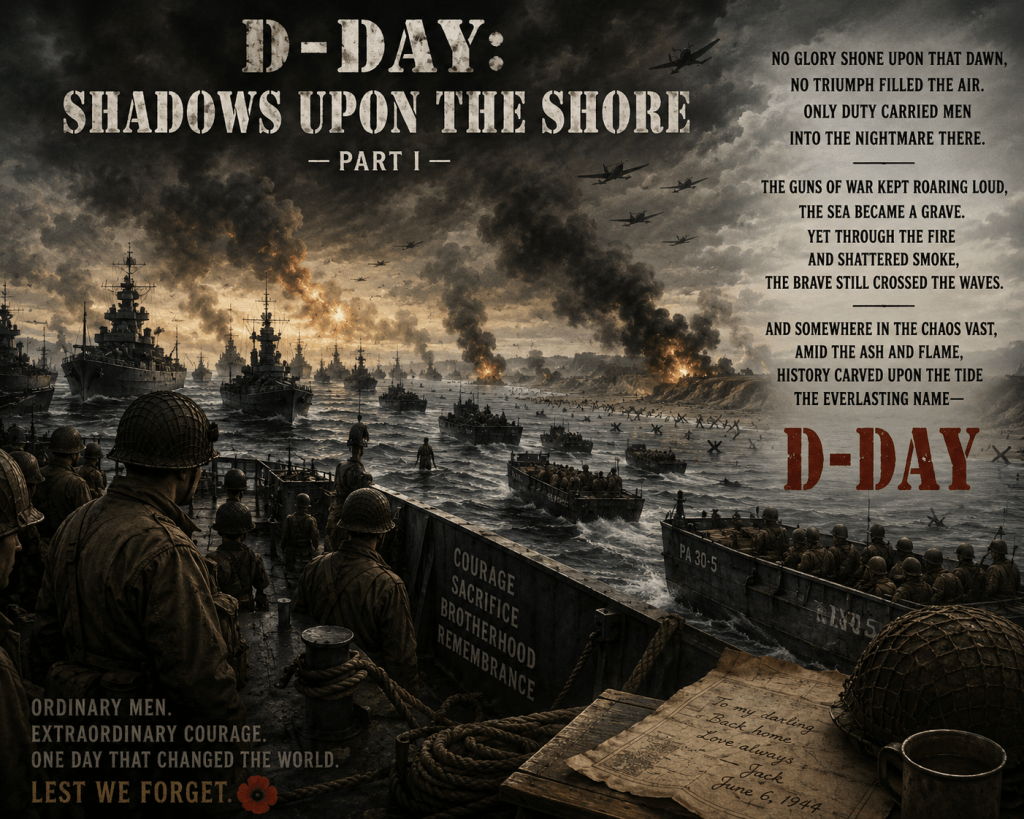
D-Day: Shadows Upon the Shore
—Part I—
Before the dawn had touched the sea,
The grey horizon stirred.
Steel giants carved the restless waves,
While no man spoke a word.
Battleships rolled through mist and smoke,
Their engines deep and low.
Like thunder waiting in the dark
For hell to soon unfold.
The channel winds blew sharp and cold,
Salt spray against pale skin.
Young sailors stared toward hidden shores,
And thought of home again.
Orders whispered through the decks,
Maps trembling in tired hands.
While somewhere far beyond the fog
Lay blood upon the sands.
Then suddenly the silence broke.
The heavens split with flame.
Great guns roared across the sea
And called the world to war again.
Smoke consumed the morning light,
Fire danced upon the tide.
Each blast shook the iron hulls
Where fear and courage collided.
Destroyers cut through boiling waves,
Cruisers answered back.
And every shell that screamed ashore
Lit death along its track.
The sea itself seemed torn apart,
Black water mixed with fire.
Yet onward steamed the waiting fleet,
Driven by grim desire.
Some men prayed beside the rails,
Some gripped letters from home.
Others smoked with trembling hands,
Knowing what must come.
Above them gulls wheeled through the smoke,
Like ghosts against the sky.
And every man aboard those ships
Knew many soon would die.
Still onward moved the mighty line,
Toward beaches stained by war.
Toward cliffs and guns and broken steel
Waiting upon the shore.
No glory shone upon that dawn,
No triumph filled the air.
Only duty carried men
Into the nightmare there.
The guns of war kept roaring loud,
The sea became a grave.
Yet through the fire and shattered smoke,
The brave still crossed the waves.
And somewhere in the chaos vast,
Amid the ash and flame,
History carved upon the tide
The everlasting name—
—D-Day—
Part I – D-Day: Shadows Upon the Shore
I wrote this opening poem to capture the terrible calm before the storm of D-Day — the vast Allied fleet crossing dark waters toward occupied France. Inspired by the voices, fears, and determination of the men aboard those ships, it reflects the weight of history, sacrifice, and the moment the world stood poised between tyranny and liberation beneath a sky lit by war.
#DDay #WarPoetry #Normandy #WW2History #LestWeForget #MilitaryPoetry
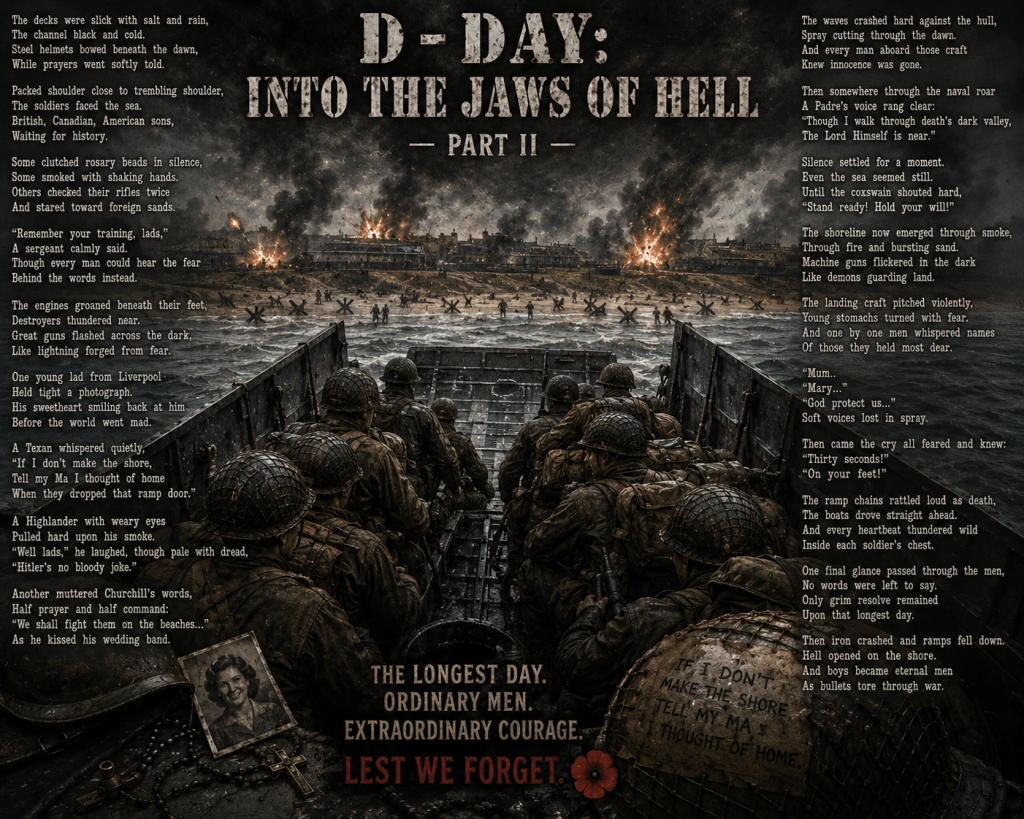
D-Day: Into the Jaws of Hell
—Part II—
The decks were slick with salt and rain,
The channel black and cold.
Steel helmets bowed beneath the dawn,
While prayers went softly told.
Packed shoulder close to trembling shoulder,
The soldiers faced the sea.
British, Canadian, American sons,
Waiting for history.
Some clutched rosary beads in silence,
Some smoked with shaking hands.
Others checked their rifles twice
And stared toward foreign sands.
“Remember your training, lads,”
A sergeant calmly said.
Though every man could hear the fear
Behind the words instead.
The engines groaned beneath their feet,
Destroyers thundered near.
Great guns flashed across the dark,
Like lightning forged from fear.
One young lad from Liverpool
Held tight a photograph.
His sweetheart smiling back at him
Before the world went mad.
A Texan whispered quietly,
“If I don’t make the shore,
Tell my Ma I thought of home
When they dropped that ramp door.”
A Highlander with weary eyes
Pulled hard upon his smoke.
“Well lads,” he laughed, though pale with dread,
“Hitler’s no bloody joke.”
Another muttered Churchill’s words,
Half prayer and half command:
“We shall fight them on the beaches…”
As he kissed his wedding band.
The waves crashed hard against the hull,
Spray cutting through the dawn.
And every man aboard those craft
Knew innocence was gone.
Then somewhere through the naval roar
A Padre’s voice rang clear:
“Though I walk through death’s dark valley,
The Lord Himself is near.”
Silence settled for a moment.
Even the sea seemed still.
Until the coxswain shouted hard,
“Stand ready! Hold your will!”
The shoreline now emerged through smoke,
Through fire and bursting sand.
Machine guns flickered in the dark
Like demons guarding land.
The landing craft pitched violently,
Young stomachs turned with fear.
And one by one men whispered names
Of those they held most dear.
“Mum…”
“Mary…”
“God protect us…”
Soft voices lost in spray.
Then came the cry all feared and knew:
“Thirty seconds!”
“On your feet!”
The ramp chains rattled loud as death,
The boats drove straight ahead.
And every heartbeat thundered wild
Inside each soldier’s chest.
One final glance passed through the men,
No words were left to say.
Only grim resolve remained
Upon that longest day.
Then iron crashed and ramps fell down.
Hell opened on the shore.
And boys became eternal men
As bullets tore through war.
Paul Baldry (LongJohn)
Part II – D-Day: Into the Jaws of Hell
This second poem follows the Allied soldiers aboard the landing craft as they prepared to storm the beaches of Normandy. Drawing from known words, prayers, humour, and memories shared by soldiers before the landings, it reflects the fear, courage, and humanity carried by ordinary young men facing one of history’s most brutal moments.
#DDayLandings #WW2Poetry #Normandy1944 #WarMemories #LestWeForget #AlliedForces
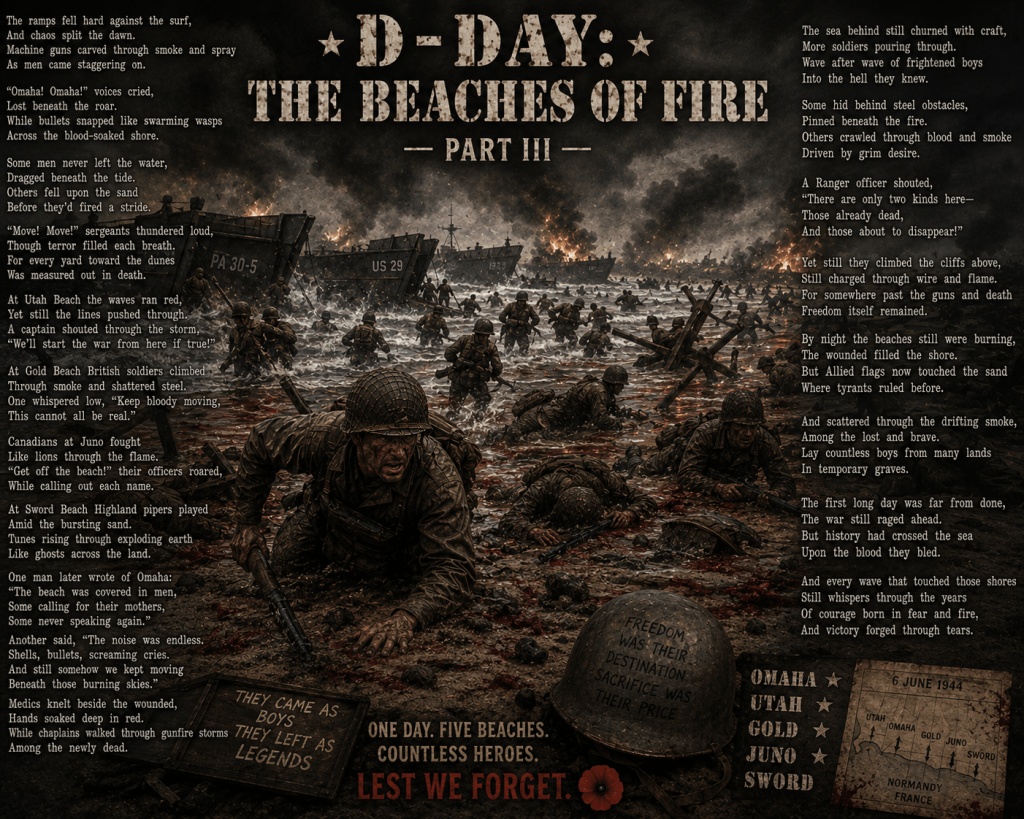
D-Day: The Beaches of Fire
—Part III—
The ramps fell hard against the surf,
And chaos split the dawn.
Machine guns carved through smoke and spray
As men came staggering on.
“Omaha! Omaha!” voices cried,
Lost beneath the roar.
While bullets snapped like swarming wasps
Across the blood-soaked shore.
Some men never left the water,
Dragged beneath the tide.
Others fell upon the sand
Before they’d fired a stride.
“Move! Move!” sergeants thundered loud,
Though terror filled each breath.
For every yard toward the dunes
Was measured out in death.
At Utah Beach the waves ran red,
Yet still the lines pushed through.
A captain shouted through the storm,
“We’ll start the war from here if true!”
At Gold Beach British soldiers climbed
Through smoke and shattered steel.
One whispered low, “Keep bloody moving,
This cannot all be real.”
Canadians at Juno fought
Like lions through the flame.
“Get off the beach!” their officers roared,
While calling out each name.
At Sword Beach Highland pipers played
Amid the bursting sand.
Tunes rising through exploding earth
Like ghosts across the land.
One man later wrote of Omaha:
“The beach was covered in men,
Some calling for their mothers,
Some never speaking again.”
Another said, “The noise was endless.
Shells, bullets, screaming cries.
And still somehow we kept moving
Beneath those burning skies.”
Medics knelt beside the wounded,
Hands soaked deep in red.
While chaplains walked through gunfire storms
Among the newly dead.
The sea behind still churned with craft,
More soldiers pouring through.
Wave after wave of frightened boys
Into the hell they knew.
Some hid behind steel obstacles,
Pinned beneath the fire.
Others crawled through blood and smoke
Driven by grim desire.
A Ranger officer shouted,
“There are only two kinds here—
Those already dead,
And those about to disappear!”
Yet still they climbed the cliffs above,
Still charged through wire and flame.
For somewhere past the guns and death
Freedom itself remained.
By night the beaches still were burning,
The wounded filled the shore.
But Allied flags now touched the sand
Where tyrants ruled before.
And scattered through the drifting smoke,
Among the lost and brave,
Lay countless boys from many lands
In temporary graves.
The first long day was far from done,
The war still raged ahead.
But history had crossed the sea
Upon the blood they bled.
And every wave that touched those shores
Still whispers through the years
Of courage born in fear and fire,
And victory forged through tears.
Paul Baldry (LongJohn)
Part III – D-Day: The Beaches of Fire
I wrote this poem to honour the men who landed on Omaha, Utah, Gold, Juno, and Sword beaches during the first terrible hours of D-Day. Inspired by eyewitness accounts and battlefield memories, it captures the chaos, fear, courage, and sacrifice that unfolded as Allied soldiers fought through gunfire, smoke, and blood to secure freedom’s foothold in Europe.
#OmahaBeach #DDay1944 #BattlefieldPoetry #WW2Remembrance #MilitaryHistory #LestWeForget
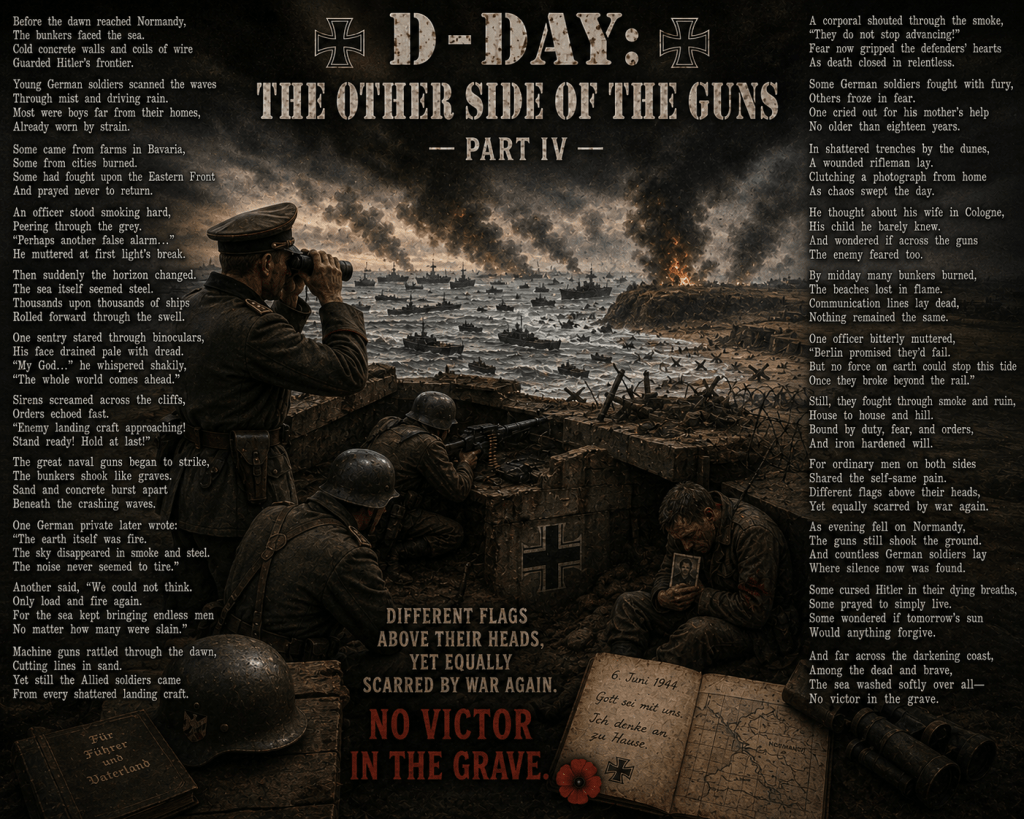
D-Day: The Other Side of the Guns
—Part IV—
Before the dawn reached Normandy,
The bunkers faced the sea.
Cold concrete walls and coils of wire
Guarded Hitler’s frontier.
Young German soldiers scanned the waves
Through mist and driving rain.
Most were boys far from their homes,
Already worn by strain.
Some came from farms in Bavaria,
Some from cities burned.
Some had fought upon the Eastern Front
And prayed never to return.
An officer stood smoking hard,
Peering through the grey.
“Perhaps another false alarm…”
He muttered at first light’s break.
Then suddenly the horizon changed.
The sea itself seemed steel.
Thousands upon thousands of ships
Rolled forward through the swell.
One sentry stared through binoculars,
His face drained pale with dread.
“My God…” he whispered shakily,
“The whole world comes ahead.”
Sirens screamed across the cliffs,
Orders echoed fast.
“Enemy landing craft approaching!
Stand ready! Hold at last!”
The great naval guns began to strike,
The bunkers shook like graves.
Sand and concrete burst apart
Beneath the crashing waves.
One German private later wrote:
“The earth itself was fire.
The sky disappeared in smoke and steel.
The noise never seemed to tire.”
Another said, “We could not think.
Only load and fire again.
For the sea kept bringing endless men
No matter how many were slain.”
Machine guns rattled through the dawn,
Cutting lines in sand.
Yet still the Allied soldiers came
From every shattered landing craft.
A corporal shouted through the smoke,
“They do not stop advancing!”
Fear now gripped the defenders’ hearts
As death closed in relentless.
Some German soldiers fought with fury,
Others froze in fear.
One cried out for his mother’s help
No older than eighteen years.
In shattered trenches by the dunes,
A wounded rifleman lay.
Clutching a photograph from home
As chaos swept the day.
He thought about his wife in Cologne,
His child he barely knew.
And wondered if across the guns
The enemy feared too.
By midday many bunkers burned,
The beaches lost in flame.
Communication lines lay dead,
Nothing remained the same.
One officer bitterly muttered,
“Berlin promised they’d fail.
But no force on earth could stop this tide
Once they broke beyond the rail.”
Still, they fought through smoke and ruin,
House to house and hill.
Bound by duty, fear, and orders,
And iron hardened will.
For ordinary men on both sides
Shared the self-same pain.
Different flags above their heads,
Yet equally scarred by war again.
As evening fell on Normandy,
The guns still shook the ground.
And countless German soldiers lay
Where silence now was found.
Some cursed Hitler in their dying breaths,
Some prayed to simply live.
Some wondered if tomorrow’s sun
Would anything forgive.
And far across the darkening coast,
Among the dead and brave,
The sea washed softly over all—
No victor in the grave.
Paul Baldry (LongJohn)
Part IV – D-Day: The Other Side of the Guns
This poem explores D-Day through the eyes of the ordinary German soldiers defending Normandy’s beaches. Inspired by historical accounts and personal recollections, it reflects the confusion, fear, duty, and humanity of young men caught in the machinery of war, reminding us that beneath different uniforms were lives forever changed by the same terrible battle.
#WW2History #GermanSoldiers #Normandy #WarPoetry #Remembrance #MilitaryHistory
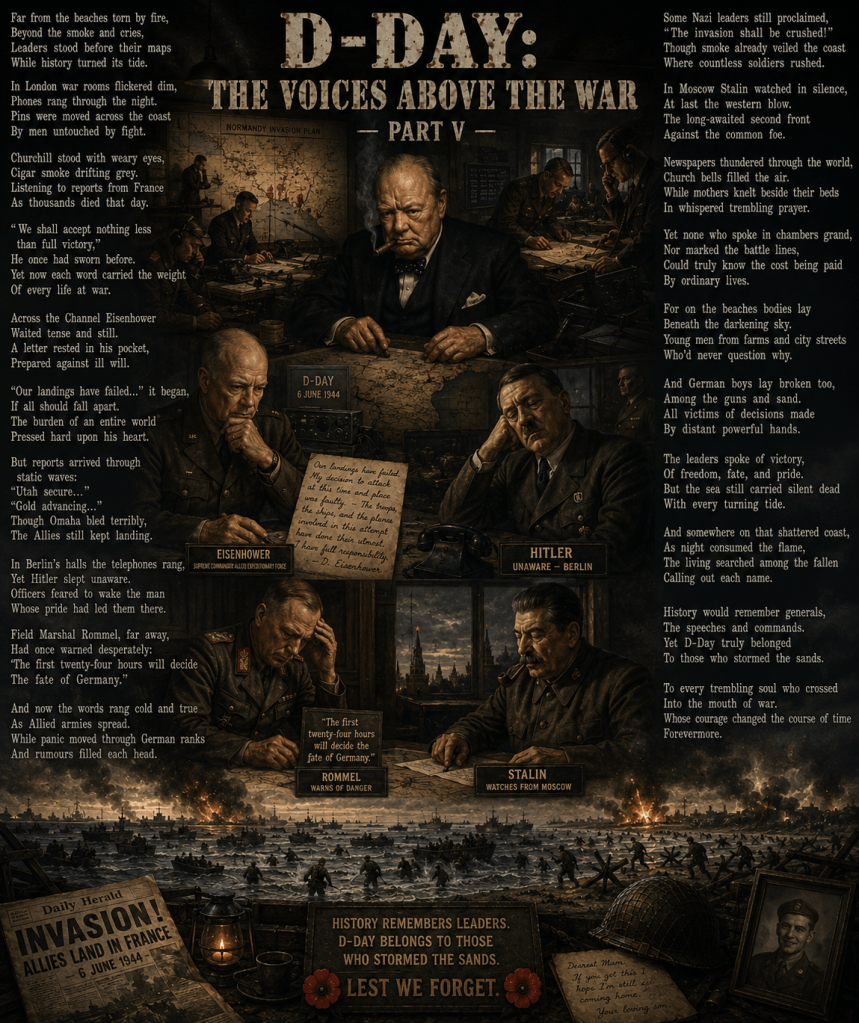
D-Day: The Voices Above the War
—Part V—
Far from the beaches torn by fire,
Beyond the smoke and cries,
Leaders stood before their maps
While history turned its tide.
In London war rooms flickered dim,
Phones rang through the night.
Pins were moved across the coast
By men untouched by fight.
Churchill stood with weary eyes,
Cigar smoke drifting grey.
Listening to reports from France
As thousands died that day.
“We shall accept nothing less than full victory,”
He once had sworn before.
Yet now each word carried the weight
Of every life at war.
Across the Channel Eisenhower
Waited tense and still.
A letter rested in his pocket,
Prepared against ill will.
“Our landings have failed…” it began,
If all should fall apart.
The burden of an entire world
Pressed hard upon his heart.
But reports arrived through static waves:
“Utah secure…”
“Gold advancing…”
Though Omaha bled terribly,
The Allies still kept landing.
In Berlin’s halls the telephones rang,
Yet Hitler slept unaware.
Officers feared to wake the man
Whose pride had led them there.
Field Marshal Rommel, far away,
Had once warned desperately:
“The first twenty-four hours will decide
The fate of Germany.”
And now the words rang cold and true
As Allied armies spread.
While panic moved through German ranks
And rumours filled each head.
Some Nazi leaders still proclaimed,
“The invasion shall be crushed!”
Though smoke already veiled the coast
Where countless soldiers rushed.
In Moscow Stalin watched in silence,
At last the western blow.
The long-awaited second front
Against the common foe.
Newspapers thundered through the world,
Church bells filled the air.
While mothers knelt beside their beds
In whispered trembling prayer.
Yet none who spoke in chambers grand,
Nor marked the battle lines,
Could truly know the cost being paid
By ordinary lives.
For on the beaches bodies lay
Beneath the darkening sky.
Young men from farms and city streets
Who’d never question why.
And German boys lay broken too,
Among the guns and sand.
All victims of decisions made
By distant powerful hands.
The leaders spoke of victory,
Of freedom, fate, and pride.
But the sea still carried silent dead
With every turning tide.
And somewhere on that shattered coast,
As night consumed the flame,
The living searched among the fallen
Calling out each name.
History would remember generals,
The speeches and commands.
Yet D-Day truly belonged
To those who stormed the sands.
To every trembling soul who crossed
Into the mouth of war.
Whose courage changed the course of time
Forevermore.
Paul Baldry (LongJohn)
Part V – D-Day: The Voices Above the War
I wrote this poem to reflect the leaders, politicians, and commanders whose decisions shaped the first days of D-Day. Inspired by the recorded words and thoughts of Churchill, Eisenhower, Rommel, Stalin, and others, it contrasts the strategy rooms of power with the brutal reality faced by the soldiers dying upon the beaches below.
#Churchill #Eisenhower #DDayHistory #WW2Poetry #LeadershipInWar #LestWeForget
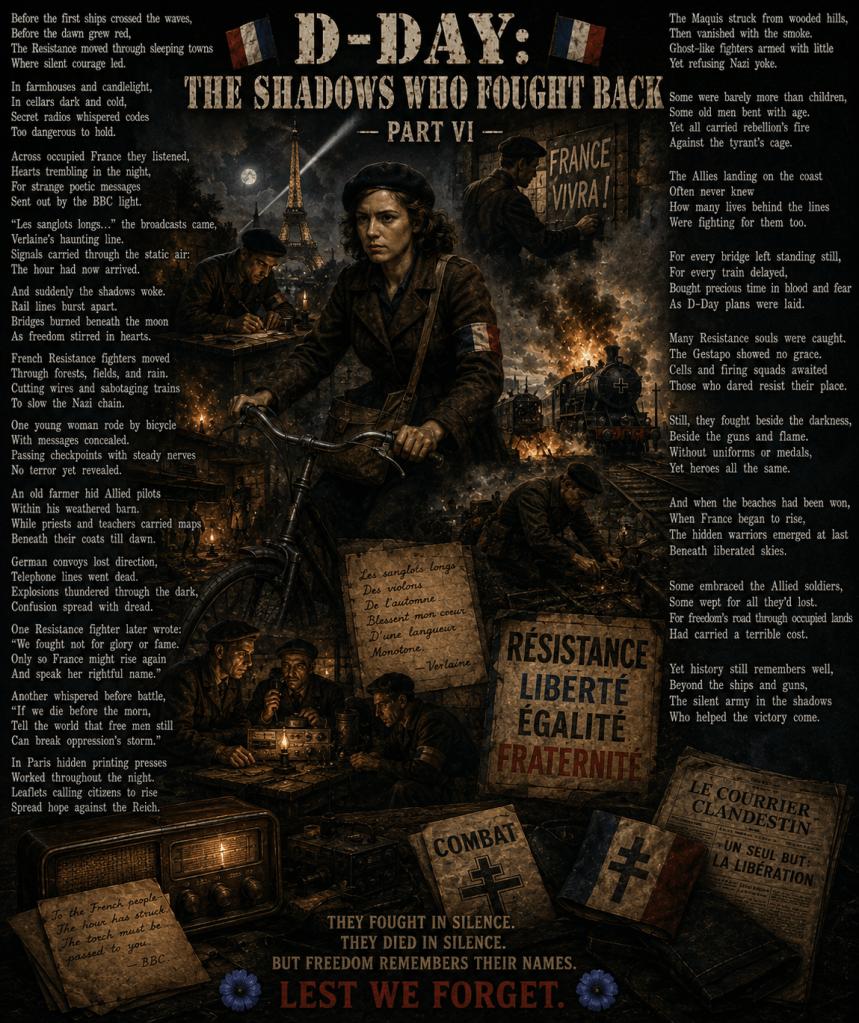
D-Day: The Shadows Who Fought Back
—Part VI —
Before the first ships crossed the waves,
Before the dawn grew red,
The Resistance moved through sleeping towns
Where silent courage led.
In farmhouses and candlelight,
In cellars dark and cold,
Secret radios whispered codes
Too dangerous to hold.
Across occupied France they listened,
Hearts trembling in the night,
For strange poetic messages
Sent out by the BBC light.
“Les sanglots longs…” the broadcasts came,
Verlaine’s haunting line.
Signals carried through the static air:
The hour had now arrived.
And suddenly the shadows woke.
Rail lines burst apart.
Bridges burned beneath the moon
As freedom stirred in hearts.
French Resistance fighters moved
Through forests, fields, and rain.
Cutting wires and sabotaging trains
To slow the Nazi chain.
One young woman rode by bicycle
With messages concealed.
Passing checkpoints with steady nerves
No terror yet revealed.
An old farmer hid Allied pilots
Within his weathered barn.
While priests and teachers carried maps
Beneath their coats till dawn.
German convoys lost direction,
Telephone lines went dead.
Explosions thundered through the dark,
Confusion spread with dread.
One Resistance fighter later wrote:
“We fought not for glory or fame.
Only so France might rise again
And speak her rightful name.”
Another whispered before battle,
“If we die before the morn,
Tell the world that free men still
Can break oppression’s storm.”
In Paris hidden printing presses
Worked throughout the night.
Leaflets calling citizens to rise
Spread hope against the Reich.
The Maquis struck from wooded hills,
Then vanished with the smoke.
Ghost-like fighters armed with little
Yet refusing Nazi yoke.
Some were barely more than children,
Some old men bent with age.
Yet all carried rebellion’s fire
Against the tyrant’s cage.
The Allies landing on the coast
Often never knew
How many lives behind the lines
Were fighting for them too.
For every bridge left standing still,
For every train delayed,
Bought precious time in blood and fear
As D-Day plans were laid.
Many Resistance souls were caught.
The Gestapo showed no grace.
Cells and firing squads awaited
Those who dared resist their place.
Still, they fought beside the darkness,
Beside the guns and flame.
Without uniforms or medals,
Yet heroes all the same.
And when the beaches had been won,
When France began to rise,
The hidden warriors emerged at last
Beneath liberated skies.
Some embraced the Allied soldiers,
Some wept for all they’d lost.
For freedom’s road through occupied lands
Had carried a terrible cost.
Yet history still remembers well,
Beyond the ships and guns,
The silent army in the shadows
Who helped the victory come.
Paul Baldry (LongJohn)
Part VI – D-Day: The Shadows Who Fought Back
This final poem honours the courage of the French Resistance during the D-Day landings. Inspired by real sabotage missions, secret broadcasts, and acts of sacrifice carried out behind enemy lines, it tells the story of the hidden army who disrupted German forces and helped make liberation possible through bravery, secrecy, and hope.
#FrenchResistance #DDay #WW2History #ResistanceHeroes #WarPoetry #Liberation
 Poetry of Life
Leave a comment