

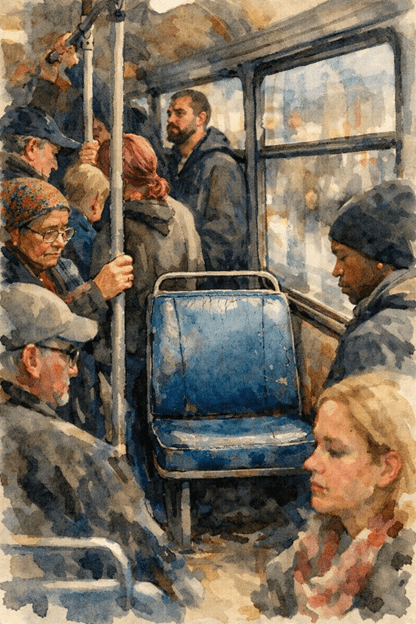
They say the bus is full,
yet space behaves strangely around you—
as if presence can be erased
without ever leaving a mark.
People hover in practiced balance,
knees locked, backs bent,
choosing discomfort over contact,
pain over proximity,
anything but nearness.
And it is here the truth is spoken plainly:
“The bus is full, yet people choose to stand,
Gripping the rails with tired, aching hands,
Rather than sit beside you and share your space,
Rejection is written clearly on each face.”
— IsabellaJoshua
That seat becomes a question no one asks aloud.
Is it your age—
too old to be invisible,
too young to be respected?
Is it your gender,
misfiled in their narrow drawers?
Your colour,
carrying history they refuse to learn?
Your race,
mistaken for a threat instead of a truth?
Or your body—
scarred, shaped, sized, softened,
refusing to apologize for existing?
Ignorance doesn’t always shout.
Sometimes it whispers,
“I’m just more comfortable standing.”
But comfort has teeth.
It breeds indifference,
teaches silence how to wound,
lets hostility stretch its legs
without ever naming itself.
Some harm arrives as laughter.
Some as slurs.
Some as hands that shove,
some as eyes that harden,
some as an empty space
that says: not you.
And still, the bus moves forward.
Still, you remain seated—
whole, breathing, undeniable.
That empty seat beside you
is not emptiness at all.
It is a record.
A mirror.
A quiet betrayal of the human race
by those who stood
when they could have simply sat.
By Paul Baldry (LongJohn)
This poem grows from a moment on a crowded bus, where one seat stays empty and silence speaks loudest. Using words by #IsabellaJoshua it explores how age, race, gender, and appearance feed ignorance, indifference, and the quiet betrayals we inflict on one another.


 Poetry of Life
Leave a comment